A poignant meditation on Cedars as our Tree of Life, this exhibit (as part of the premiere of Cedar Woman) features artists: Xwalacktun OBC, Angela Paul, Aaron “Splash” Moody, Ocean Hyland / shḵwen̓/ ts;simtelot, Atheana Picha, Sierra Tasi Baker/ K̓esugwi’lakw, Rebecca Baker Grenier/ Hawilkwalał and Dr T’uy’t’tanat Cease Wyss.
Curator: Tasha Faye Evans
Cedars are our Tree of Life. They house us, transport us, have held our newborns, and also our old ones on their way home. Cedar blesses, clears away that which we no longer need, and gifts us with clean air to breath. Cedar holds onto the land, the ancient roots absorbing disease. Cedars are danced in ceremony, made into masks, and carved to tell beautiful histories. This city is built on land made of mother tree on top of mother tree on top of mother trees.
There is less than 3% of productive old growth forests left in BC, and in this moment these ancient forests continue to be logged. Pacheedaht Elder Bill Jones describes his land now as “practically naked… we have to save what we can.” Grand Chief Stewart Phillip has called for a First Nations-led approach to old growth conservation, and leaders like the late Squamish Nation Chief Bill Williams worked to map and protect these ancient spaces, not as timber, but as spirit places necessary for our survival. In the Nuu-chah-nulth language, as cultural educator Gisele Martin teaches, the word for tree is sūcas which translates as “landholder.” Cedar holds the earth together, filters our air and water, and carries the memory of this coast. We need to protect what’s left of these ancient forests, more than a valuable resource but as the places where the old ones sing.
I have brought these artists together in this collection to honour cedar and the many gifts Cedar brings to us as our Tree of Life. Each of these artists Dr T’uy’t’tanat Cease Wyss, Xwalacktun OBC, Angela Paul, Aaron “Splash” Moody, Ocean Hyland, Atheana Baker, K̓esugwi’lakw and Rebecca Baker-Grenier are also brilliant leaders. Each living their lives according to the teachings of cedar and original laws of protecting what is sacred to ensure a future of health and prosperity for all our relations.
Credits:
- Ecological data: Price, K., Holt, R. F., & Daust, D. (2021). Conflicting portrayals of remaining old growth: the British Columbia case. Canadian Journal of Forest Research, 51(5), 742–752.
- Elder Bill Jones quote: Jones, B. (2021). Interview statement regarding logging on Pacheedaht territory. As reported by The Associated Press / PBS NewsHour.
- Grand Chief Stewart Phillip quote: Phillip, S. (2023). Executive Statement on the Protect Our Elder Trees Declaration. Union of BC Indian Chiefs (UBCIC).
- Sūcas teaching: with gratitude to Tla-o-qui-aht cultural educator Gisele Martin for sharing this linguistic and ecological knowledge.
- Chief Bill Williams: with respect to his legacy in mapping and protecting old-growth spaces on Squamish territory.
Tasha is a Coast Salish dance and theatre artist, educator, and consultant. Her body of work is an intersection of artistic practice, culture, and education woven into dance and theatre performances, city-wide cultural reclamation projects, and innovative curriculum. Her current projects include Cedar Woman, a dance honouring a legacy of Coast Salish women spanning all the way back to a tree, and In the Presence of Ancestors, a life-long exhibition of five Coast Salish House posts carved and raised in Port Moody. With decades of creation and production, Tasha has participated in performances and festivals nationally and internationally.
Artist: Xwalacktun OBC
Photographer: Erik Zennstrom
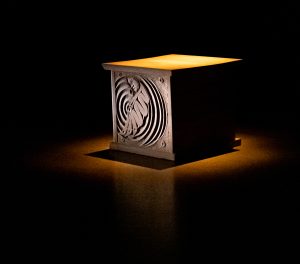
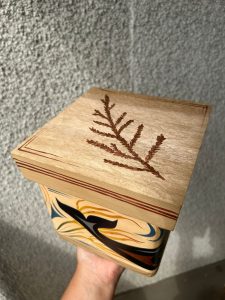
This carving was commissioned by Tasha Faye Evans to be included in her dance of Cedar Woman. This box tells the story of how the xaays transformed one of our first grandmothers into a cedar tree because she loved fiercely during the Great Flood. Cedar boxes have many purposes in our culture. Some are known as spirit boxes, some are meant to carry precious belongings, some are carved to signify the house a family belongs to. This wood for this cedar box comes from a 750 year-old growth cedar tree from the Elaho Valley.
Xwalacktun, also known as Rick Harry, is a descendant of Squamish and Kwakwak’wakw ancestry. He creates native art that bridges the past, present, and future, echoing the traditions of his ancestors. With a deep spiritual connection, he collaborates with clients to infuse each piece with personal narratives, breathing life into his creations.
Specializing in Coast Salish style, Xwalacktun seamlessly blends tradition with contemporary expression, catering to a diverse clientele from individuals to corporations. His artworks transcend decoration, becoming cherished treasures and iconic landmarks.
He has adorned prestigious locations with his commissioned works, from intricately carved doors at B.C. Hydro and the University of Victoria First People’s House to striking sculptures at the Audain Museum in Whistler. His craftsmanship has earned accolades including the Georgie Award in 2002 and the Arthur G. Hayden Medal at the 31st Annual International Bridge Conference Awards.
Driven by a commitment to excellence and cultural preservation, Xwalacktun continues to push boundaries in native art, leaving an indelible mark on both the artistic landscape and the communities he serves. xwalacktun.com
Artist: Qʷənat ~ Angela Paul
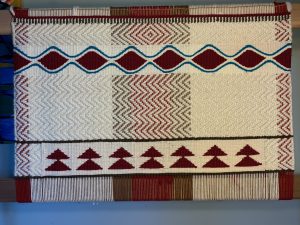
Angela Paul carries two ancestral names, sits’sáts’tenat and qʷənat. This Coast Salish mother of fur has dedicated her career to the betterment of First Nations people and communities.
Traditionally groomed, she has a strong understanding of her culture and spiritual teachings and the impacts of colonization and barriers that plague First Nations communities. She has a strong passion in traditional canoe racing, weaving and cultural singing and dancing and believes that practicing traditions, having a strong sense of identity and connection to our ancestors and traditional lands and waters is vital to community wellness, development and sustainability.
Angela has recently completed an MBA focusing on Aboriginal Business Leadership at SFU. Angela is humbled by the gift of traditional weaving—she holds this connection to her late mother and Squamish ancestry dearly. She loves to learn and teach weaving and strives to carry this sacred practice with the utmost integrity.
——————————-
My focus for this piece is the importance of sustaining ancient knowledge and wisdom of Xapayay. The lifespan of Xapayay ~ the cedar tree is shown here with the seedlings encased in water being nurtured and protected. The journey of life and growth is shown with the zigzag twill design. We can draw on and learn from this ancient knowledge. We have roles and responsibilities to uphold the integrity of the knowledge of seven generations back and sustain this integrity for the coming next seven generations.
The red eye shape designs are cedar seedlings encased in ancient wisdom (white) and water (the turquoise colour) which is bringing it to life. There are seven to represents seven generations. The ancient knowledge is rooted to our ancestors and the zigzag design I am working on now shows the roots and connection to our ancestral laws and teachings held within the cedar tree and within each and every one of us.
The piece represents the Cycle of Cedar’s life, Standing Tall like the Cedar is a part of the theme. The story of this piece represents the responsibility we have to sustain the ancient knowledge of our ancestors, held in the cedar tree (triangle figures at the bottom). The old cedar trees are our ancestors. The zigzag twill design element represents the trail of our lifetime, our roots and connection to our ancestors (7 generations back) to the children and grandchildren to come (7 generations forward) the 7 eye shaped designs within the blue wave design are the red cedar seedlings that represent the 7 generations to come. We are responsible to them. We must carry the ancient knowledge, wisdom and teachings of our sacred ancestors with integrity. The cedar tree shows us how to stand tall with strong roots and far reaching branches to represent our respective families, communities and nations. The colours and checkered patterns are showing us that male/female balance is important and we must carry on with respect, balance, harmony, connection, and peace.
Artist: Aaron “Splash” Moody
Photographer: Nancy Bleck
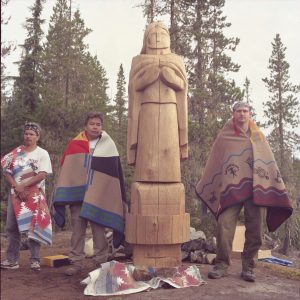
Aaron Nelson-Moody / Tawx’sin Yexwulla, from Squamish First Nation, is an educator who works to rekindle Coast Salish art and culture in public education and Indigenous community. Much of his time has been spent making tools for traditional pursuits, or creating his own work in metal, stone, wood, or graphic design.
He currently works part time at Langara College Fine Arts as an instructor teaching Indigenous Woodcarving, at Emily Carr University teaching metalsmithing, and at a residency at Simon Fraser University creating Coast Salish weaving tools. He is often known as “Splash,” a name he earned on several Tribal Journeys canoe trips along the coast surrounding the Salish Sea.
——————————–
The women who inspired the carvings are real. A chance encounter with a society of women who understand the state of the plant and animal life of our traditional territories not just within their own lives, but over many centuries. Because that is the lifespan of the cycles of the forest, the animal migrations, the spawning salon patterns, and the ebb and flow of the glaciers over the lands we lived on and in.
This society of women were raised into this training, to see and understand the long history, patterns not visible within one lifespan. They would raise the next generation of girls into these teachings, and also visit with their counterparts in nearby territories, because it isn’t enough to see only this one part of the world without understanding all the parts are related and are interacting.
I think Nancy Bleck first called the carvings the Cedar Women, and our late Chief Williams wanted these carved figures as temporary reminders until we re-engage in this work of caring for our home. The Chief said it may look different in the future, perhaps with a Masters degree alongside our traditional teachings, and maybe in the future the settlers will see the value of caring for this place with the same care. Four of these Cedar Women figures were carved, three are in upper Squamish Valley, and one more accessible in the Squamish/Lilwat Cultural centre in Whistler.
Artist: Ocean Hyland/ shḵwen̓/ ts;simtelot
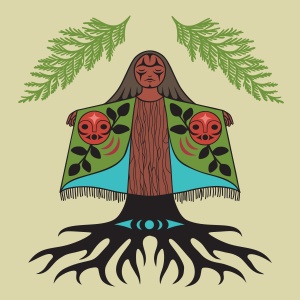
Cedar Woman has been a beautiful medicine I have been working with alongside Tasha for many years.
Cedar Woman has revealed many stories and brought together pieces of her medicine from many women that carry the work of looking after their people.
In this iteration I chose to show her rooted in the ground, in her shawl are young little spirits she is embracing. Represented as huckleberries, honouring the teaching that often huckleberries often grow where old cedars once grew.
Ocean Hyland is an artist who works in the realms of painting and digital design. Along with her practices she enjoys participating in language revitalization of coast Salish languages.. Ocean currently lives in Qualicum Bay on Vancouver Island.
As a young woman, Ocean received the ancestral name ts;simtelot which was shared with her by her Mother. This name has been passed down through her family on her Cheam side. On her matrilineal side she is Tsleil Waututh, Squamish, Cheam, Hawaiian, and Chinese. Through her father she is Scottish and Irish. The richness and diversity of her cultural heritage is what inspires Ocean in her many art practices.
Ocean has studied at both Native education college specializing in NWC jewelry arts, and at Simon Fraser University focusing on the sḵwx̱wú7mesh sníchim, building up her proficiency in one of her mother tongues. She has also gained valuable knowledge apprenticing with creators `Zachary George and Aaron Nelson Moody.
Shḵwen̓| oceanhyland17[at]gmail.com | salishshkwen.com
“shḵwen̓ kwi en sna, chen íp’is kwi kwshámin ts;simtelot. chen tína7 tl’a átsnach úxwumixw.*
——————————-
As an indigenous artist, I continuously strive to deepen my understanding of my art practices and what that means to my culture and community. I paint, draw, carve/engrave, and weave. I also study the Squamish, Hulqumí’num, and pentl’ach languages.
I love working for my community and I enjoy collaborating with artists who are committed to enriching the communities they live in. I am continually learning how to navigate what it means to be an indigenous artist upholding the values of my community as well as the values held in creating art in the contemporary world. I will strive to carry these tools and knowledge the best I can to share as those before me always have.
*Ocean is my name, I carry the ancestral name ts;simtelot. I am from the village that sits between the mountains and the bay.
Artist: Atheana Picha
Atheana Picha is a Coast Salish Artist From The Kwantlen First Nation, and her grandmother was from Tsartlip. Atheana was given the name Nash’mene’ta’naht by Gerry Oleman from the St’at’imc First Nation, which translates To “Go-Getter Woman”. Born In Vancouver, she grew up and works out of Richmond, BC. She is an Interdisciplinary artist, working mostly In 2-Dimensional media.
Atheana has been doing two Apprenticeships learning Salish Wool Weaving with Musqueam Weaver Debra Sparrow since 2019, and learning Silver Engraving, Wood Carving, and Tool Making with Squamish Artist and Educator Aaron Nelson-Moody since 2018.
Atheana’s practice is grounded In learning more about Salish Design through studying the old pieces, observing nature, and learning from her Elders and Teachers.
“When I was thinking about this box and its work, I thought about who I pray to. I pray to the ancestors and I use water. My aunty Nickie told me when I was asking her about water, that she was taught by her granny to go to where old medicine meets new medicine, where fresh water meets salt water. I was thinking of the ancestral beings in these waters, the white sturgeon and the killer whale, and what they mean to me and my ancestors.”
Artist: Dr. T’uy’t’tanat Cease Wyss

T’uy’t’tanat-Cease Wyss’ heritage includes Sḵwx̱wú7mesh, Stó:lō, Kānaka Maoli, Irish-Métis, and Swiss. Her Sḵwx̱wú7mesh traditional name, T’uy’t’tanat, means “woman who travels by canoe to gather medicines for all people.” Wyss is an ethnobotanist, community gardener and interdisciplinary artist who works in digital media, storytelling and weaving.
—————————–
Title: lam̓ tl’a míx̱alh Na ta stalkaya úxwumixw
lam̓ tl’a míx̱alh
Na ta stalkaya úxwumixw
Re::
lam̓ tl’a míx̱alh [lam̓ tl’a mi x̱alh] den of black bear; lair of black bear.
noun.
Na ta stalkaya úxwumixw ::
In stalkaya village
From Senaqwila: my teacher
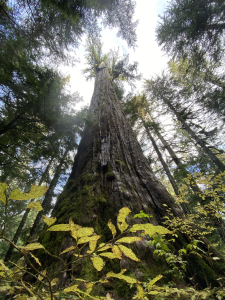
This image is one of many I’ve taken through numerous forest walks, in the few ancient and old growth forests that I have been blessed to walk-through. They’re not easy places to get to, because colonialism and the deforestation have made these spaces so tiny and out of reach, due to cut blocks and rough logging roads. And in a way it’s good, because they’re hard to get to. And Humans have proved way too often that they don’t really have respect for ancient and old growth forests, so the less human activity in these places, the better. If they are to even continue surviving at the state that they’re in right now, we need less human traffic there and just animals doing their thing, and the fact that animals have been pushed to these tiny postage stamp forests should tell us we need to stop taking space everywhere just because we’re curious.
This gorgeous X’eyp’ey / Yellow Cedar Tree, is 1800+ years old and hosts an enormous Míx̱alh / Bear Den that would easily house 1-2 full grown bears + 4 bear cubs, although we all know that in reality the mothers den on their own with their cubs. And on average give birth to 1-2 cubs a season.
It took literally several hours to get up to this particular Bear Den, combined with driving and hiking, and it was so worth it to see this place and to be able to hug this tree and tell this beautiful ancient being how incredibly important it is to the world. And that we need more protection around the very few ancient and old growth cedars [and other giant trees that we have], and particularly full protection of both red and yellow old growth and Ancient Cedars.
I’m so grateful to my team with “Sanctuary”, Damien Gillis and Olivier Leroux, for bringing me out to these spaces and this one in particular because it’s in my territory, and that I have had these opportunities to see these ancient giants up close, and to interact with them in culturally,spiritually and physically meaningful ways, that have helped me grow and deepen my love of all trees and all of their wondrous stages.
I urge you all to consider planting a consistent number of trees per year, and committing to removing invasive species from forests, as well as other ways to help manage forests in meaningful ways that support it not destroy it.
And to commit to supporting indigenous forest garden projects in urban spaces with Indigenous youth.
Artist: K̓esugwi’lakw, Sierra Tasi Baker (they/them)
Sierra is an Indigiqueer urban and environmental designer by day, performance artist, dancer and choreographer by night. Sierra is from the Sḵwx̱wú7mesh Úxwumixw (Squamish Nation) and is also Kwakwa̱ka̱ʼwakw/Musga̱mgw Dzawada̱’enuxw, Łingít (Tlingit), and Magyar/Hungarian.
Sierra’s ancestral Kwak̓wala name, K̓esugwi’lakw, means “Creator” or “Creative One” or “One Who Carves Wealth/the Supernatural into the World”. K̓esugwilakw comes from a family of artists and entrepreneurs, growing up in their North-West and Coast Salish cultures in the Sḵwx̱wú7mesh village of Eslhá7han with ancestral connections to their Northern Village of G̱wa’yasda̱ms.
K̓esugwi’lakw holds a Masters of Science in Sustainable Urbanism from the Bartlett School of City Planning from University College London, a Bachelors in Environmental Design from the University of British Columbia’s School of Architecture and Landscape Architecture. They have 10+ years of performing and designing professionally. This has made them as salty as the Salish sea…
Critiquing colonialism Sierra focuses on decolonization through queering design and performance art. Combining Indigenous design and research methodologies, oral history, primary archival research, Traditional Ecological Knowledge (TEK), and embodied knowledge to develop uniquely queer, environmental, urban design and choreographed sovereign solutions.
Choreographing space, working with concepts of shapeshifting, time, transformation, origin and healing. K̓esugwi’lakw’s forms of “embodied storytelling” works to challenge their audiences to question what is traditional and what is contemporary?
@kesugwilakw @sierratasibaker
—————————-
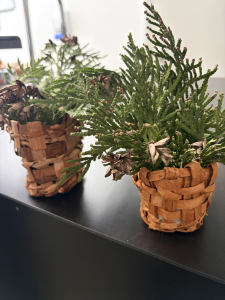
These cedar baskets carry the cones of a cedar tree which indicates its intersex nature. Cedar appears as a grandmother or grandfather in different legends across the West Coast. Revealing aspects of its Two-Spirit identity in different ways. Germinating cones are often found reaching skyward and smaller pollinating cones are often found drooping downwards, sometimes even on the same branch. These are often referenced by the well known coastal symbol for welcome, with raised arms upwards with palms inwards representing a “female” cedar bough, and the lesser known symbol for closed entry or “away”, with arms extended downwards with palms facing forwards, representing a drooped “male” pollinating bow. This can indicate concepts of consent, welcome, and hosting in our culture. Cedar is known as Monoecious meaning “one-house” in Latin because its both sexes are hosted on the same tree, in one house.
Artist: Rebecca Baker-Grenier, Hawilkwalał
Limited Viewing – Dates to be Announced
Rebecca is of Kwakiuł, Dzawada’enuwx, and Sḵwx̱wú7mesh ancestry. She is a multidisciplinary artist with a BA from the University of British Columbia with a Major in the Indigenous Studies Program. Rebecca began fashion design in 2021 and is apprenticing under established Indigenous designer and artist, Himikalas Pam Baker. She completed the Indigenous Couture Residency at the Banff Centre for the Arts and Creativity, 2022.
Rebecca debuted her first full collection at New York Fashion Week, September 2022, followed by Vancouver Indigenous Fashion Week. She has presented her collection at SWAIA Santa Fe Indian Market fashion show, August 2023, Vancouver Fashion Week, 2023, Vancouver Indigenous Fashion Week 2023/ 24, and Indigenous Fashion Arts, Toronto 2024. She was the recipient of the 2021 YVR Emerging Artist award for her fashion design. Her dress, ‘Wazulis’ was on display at the YVR Vancouver Airport, 2022 and was part of an exhibit at the Museum of Vancouver, 2023. Her cedar and ermine cape was on display at the Bill Reid Gallery, 2023-24 and her vest and skirt ‘Held by Generations’ is at the Museum for Natural History, New York 2024-25. She was featured in the October 2024 issue of Elle Canada. Her work has also been featured in Vogue and worn on red carpets.
There is an intimate ancestral connection with the art that Rebecca creates, representing her lineage as an Indigenous woman. Rebecca has been creating her personal and families’ sewn and beaded pow-wow regalia since the age of eleven. She is the regalia designer for the Dancers of Damelahamid’s productions (2016 – present) with her works dancing on national and international stages
————————————
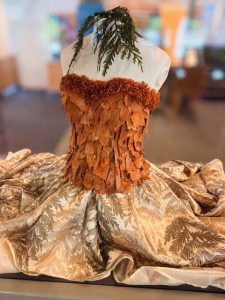
This bustier is crafted from old growth cedar, and traditionally tanned deer hide. The cedar shavings are remnants from a carved mask by Kolten Khasalus Grant, gathered from the floor of the carving space and repurposed into a new form. This piece honors the teaching: to use all parts of a being with respect and intention. Nothing is wasted. The cedar is transformed again and its spirit carried forward. Blending traditional materials with modern form, this work becomes both a reclamation and continuation of cultural practice, reminding us that life is cyclical, and that art can be regenerative.
This bustier was the catalyst for Rebecca’s recent collection “Our Roots Run Deep,” which looks at the integral relationship between waterways and the neighbouring forest systems, our cultural connection within this relationship, and the impact of colonial and extractive practices on these relationships. It was inspired by her three poems:
Yesterday: a love letter to Cedar
Cedar, our tree of life
I am of you
You are the bones that are the structure of this sacred house, this body
You are the vessel that connects me to the water and the paddles that move me
The weaving, weft and warp
Wrapped around me, branches holding me
Seedlings and ashes
My ancestor, my relative, my breath
I will return to you
We will grow again.
Tomorrow: in memory of River
I come to the river but there is no water
I stare out reflecting what once was
A lifeline, the veins that fueled the earth
Interconnected, all abundance, our essence
You were more than we knew
I mourn you my sister
My tears keep flowing
I imagine them bringing you back to life
Replenishing what we took of you
But it is too late
You are gone
Today: what will you do?
Artist: Thomas Johnny chew-yalsh, working hands
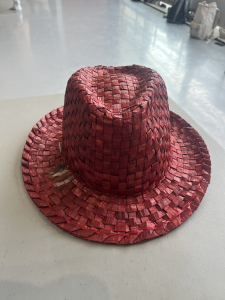
Lytton BC
Thomas Jonny Chew-yalsh is an Indigenous Canadian figure. He is notably known for his appearance as an interviewee in the 2022 documentary film A Cedar Is Life, a project that explores the fundamental and sacred importance of the cedar tree to the Indigenous communities of the Pacific Northwest Coast.
Artist: Desiree Peters Kwe-lather-wet
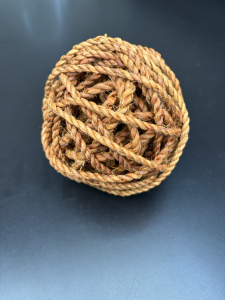
Kwikwetlem, Statimc, Stolo, Nlakapamux
We teach our culture so we can heal our families. There’s medicine in cedar. When we weave, when we work with cedar, we are healing.